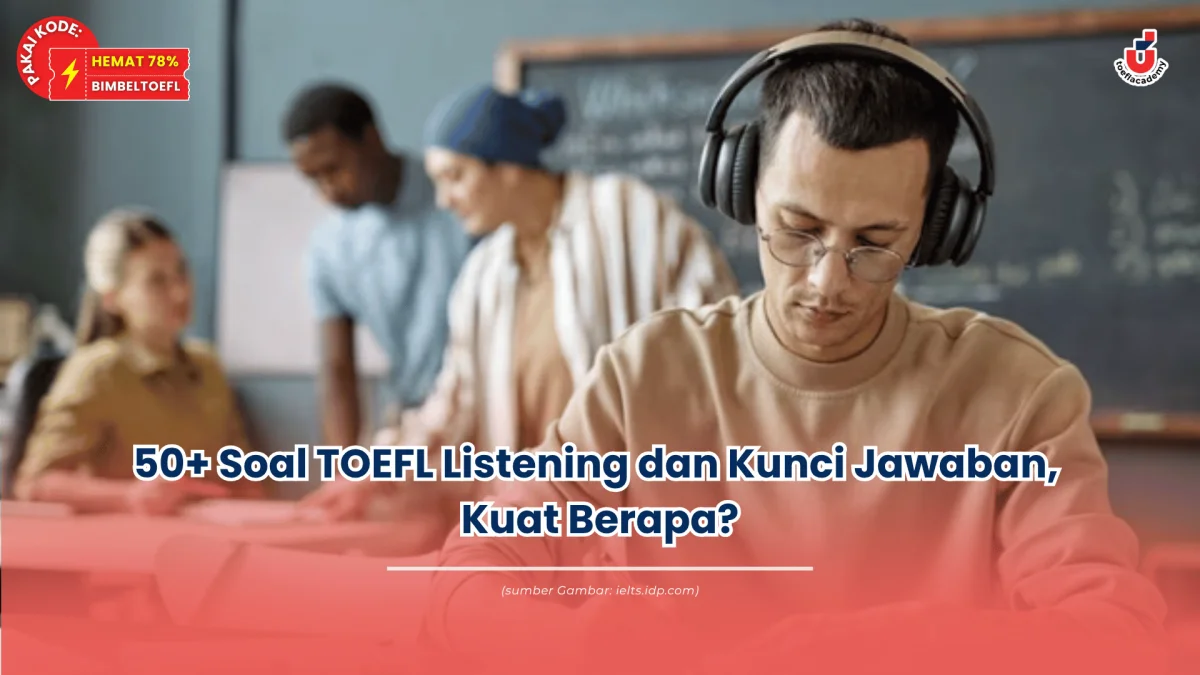
50+ soal TOEFL Listening ini berisi 52 soal lengkap dengan transkrip, kunci jawaban, dan pembahasan singkat. Susunannya mengikuti tiga bagian Listening Comprehension TOEFL ITP, yaitu Part A, Part B, dan Part C.
Perlu dicatat, semua soal di sini bersifat ilustratif. Soal-soalnya meniru format resmi dari ETS, tetapi bukan soal asli tes TOEFL. Selain itu, tes asli hanya memakai audio tanpa teks, dan audionya tidak diulang. Jadi, coba baca transkripnya sekali saja, lalu jawab tanpa melihat ulang.
Baca juga: Skornya Bisa Sampai 677! Kenali TOEFL ITP dan Sistem Penilaiannya
50+ Soal TOEFL Listening Part A Short Conversations

Woman: “Did you finish reading the novel for literature class?”
Man: “I couldn't put it down.”
Narrator: What does the man mean?
- AHe lost the book.
- BHe found the book boring.
- CHe put the book on the shelf.
- DHe read the book eagerly.
Lihat Jawaban
Man: “I'm thinking about dropping chemistry.”
Woman: “Why don't you talk to your advisor first?”
Narrator: What does the woman suggest?
- ADropping the class immediately.
- BConsulting his advisor.
- CStudying with her.
- DTaking another chemistry class.
Lihat Jawaban
Woman: “The new café on campus is always packed.”
Man: “That's because the prices are so reasonable.”
Narrator: What does the man imply?
- AHe prefers the old café.
- BMany students go there because it is affordable.
- CThe café is closing soon.
- DThe café is too expensive.
Lihat Jawaban
Man: “Can I borrow your calculator for the exam?”
Woman: “I'd lend it to you if I weren't using it myself.”
Narrator: What does the woman mean?
- AThe exam does not allow calculators.
- BShe needs her calculator for the exam.
- CShe will lend him the calculator.
- DShe does not own a calculator.
Lihat Jawaban
Woman: “Have you seen my umbrella?”
Man: “Isn't that it by the door?”
Narrator: What does the man imply?
- AIt is not raining.
- BShe should buy an umbrella.
- CHe took the umbrella.
- DThe umbrella may be near the door.
Lihat Jawaban
Man: “This assignment is due tomorrow, and I haven't even started.”
Woman: “Better late than never.”
Narrator: What does the woman mean?
- AThe deadline has been extended.
- BHe should start now even though it is late.
- CShe has finished hers.
- DHe should not do the assignment.
Lihat Jawaban
Woman: “I'm going to the post office. Want me to mail your letter?”
Man: “That would save me a trip.”
Narrator: What does the man mean?
- AHe wants the woman to mail his letter.
- BHe is going on a trip.
- CThe post office is closed.
- DHe has already mailed his letter.
Lihat Jawaban
Man: “How was the job interview?”
Woman: “I think it went better than I expected.”
Narrator: What does the woman mean?
- AShe feels positive about the interview.
- BShe did not attend the interview.
- CThe interview was cancelled.
- DShe arrived late for the interview.
Lihat Jawaban
Woman: “I can't hear the speaker very well from back here.”
Man: “Let's move closer to the front.”
Narrator: What will the speakers probably do?
- ASit nearer the front.
- BLeave the room.
- CAsk the speaker to stop.
- DTurn up the music.
Lihat Jawaban
Man: “Did Professor Wijaya accept your late paper?”
Woman: “Only after I explained that I was sick.”
Narrator: What does the woman mean?
- AShe did not submit a paper.
- BShe was sick on the day of the exam.
- CThe professor accepted the paper because of her illness.
- DThe professor refused her paper.
Lihat Jawaban
Woman: “Is the bookstore open on weekends?”
Man: “Only on Saturday mornings.”
Narrator: When can the woman visit the bookstore on the weekend?
- AOn Saturday evening.
- BOn Sunday morning.
- COn Saturday morning.
- DAt any time during the weekend.
Lihat Jawaban
Man: “I've never been so tired in my life.”
Woman: “Neither have I.”
Narrator: What does the woman mean?
- AShe has never worked before.
- BShe wants to go out tonight.
- CShe is also extremely tired.
- DShe is not tired at all.
Lihat Jawaban
Woman: “Should we take a taxi to the airport?”
Man: “The train is faster at this hour.”
Narrator: What does the man imply?
- AThey should drive themselves.
- BThey should take the train.
- CThe taxi is cheaper.
- DThey will miss the flight.
Lihat Jawaban
Man: “Your presentation was excellent.”
Woman: “Thanks, but I owe it all to my group.”
Narrator: What does the woman mean?
- AShe owes money to her group.
- BShe did the presentation alone.
- CThe presentation was poor.
- DHer group helped her greatly.
Lihat Jawaban
Woman: “Are you coming to the study group tonight?”
Man: “I'll be there if I can finish my lab report.”
Narrator: What does the man mean?
- AHe does not like the study group.
- BHe has finished his lab report.
- CHe will definitely come.
- DHis attendance depends on his lab report.
Lihat Jawaban
Man: “The heater in our room isn't working.”
Woman: “Let's call maintenance right away.”
Narrator: What will the woman probably do?
- AContact the maintenance staff.
- BMove to another room.
- CFix the heater herself.
- DOpen the window.
Lihat Jawaban
Woman: “I lost my student ID card.”
Man: “You can get a replacement at the registration office.”
Narrator: What does the man suggest?
- ABorrowing his card.
- BAsking the library for help.
- CGoing to the registration office.
- DLooking for the card at home.
Lihat Jawaban
Man: “Was the movie as good as the reviews said?”
Woman: “Not by a long shot.”
Narrator: What does the woman mean?
- AShe agreed with the reviews.
- BShe did not see the movie.
- CThe movie was very long.
- DThe movie was much worse than the reviews suggested.
Lihat Jawaban
Woman: “Why is the parking lot so empty today?”
Man: “Didn't you hear? Classes are cancelled because of the flood warning.”
Narrator: What can be inferred about the woman?
- AShe did not know that classes were cancelled.
- BShe parked in the wrong place.
- CShe has a class this afternoon.
- DShe heard the flood warning.
Lihat Jawaban
Man: “Do you mind if I open the window?”
Woman: “Actually, I'm feeling a bit cold.”
Narrator: What does the woman imply?
- AShe needs a doctor.
- BShe prefers that the window stay closed.
- CShe will leave the room.
- DShe wants the window open.
Lihat Jawaban
Woman: “I'm going to run for student council president.”
Man: “You've got my vote.”
Narrator: What does the man mean?
- AHe will not vote this year.
- BHe thinks she should not run.
- CHe supports the woman.
- DHe wants to run too.
Lihat Jawaban
Man: “Where did you buy that jacket?”
Woman: “It was a gift from my sister.”
Narrator: What does the woman mean?
- AShe bought it for her sister.
- BShe did not buy the jacket herself.
- CHer sister sells jackets.
- DShe bought it at a market.
Lihat Jawaban
Woman: “This textbook costs almost a hundred dollars.”
Man: “Have you checked the used bookstore?”
Narrator: What does the man suggest?
- ADropping the course.
- BLooking for a cheaper secondhand copy.
- CBorrowing his textbook.
- DPaying the full price.
Lihat Jawaban
Man: “I'm not sure I can carry all these boxes.”
Woman: “Here, let me give you a hand.”
Narrator: What will the woman probably do?
- AShow him her hand.
- BClap for the man.
- CLeave the boxes behind.
- DHelp the man carry the boxes.
Lihat Jawaban
Woman: “Did you remember to turn off the stove?”
Man: “Oh no, I'd better go back and check.”
Narrator: What will the man probably do?
- ACall the fire department.
- BBuy a new stove.
- CCook dinner.
- DReturn home to check the stove.
Lihat Jawaban
Man: “The lecture has been moved to Room 204.”
Woman: “Thanks for the heads-up.”
Narrator: What does the woman mean?
- AShe appreciates the information.
- BShe does not want to attend.
- CShe will raise her head.
- DShe already knew about the change.
Lihat Jawaban
Woman: “How long have you been waiting for the bus?”
Man: “Long enough to finish two chapters of my book.”
Narrator: What does the man imply?
- AHe finished the whole book.
- BThe bus came quickly.
- CHe has just arrived.
- DHe has been waiting for a long time.
Lihat Jawaban
Man: “I can't decide between the blue shirt and the white one.”
Woman: “Why not get both?”
Narrator: What does the woman suggest?
- ANot buying any shirts.
- BAsking the shop assistant.
- CChoosing the blue one.
- DBuying both shirts.
Lihat Jawaban
Woman: “Has the professor graded our essays yet?”
Man: “Not that I know of.”
Narrator: What does the man mean?
- AHe has not written his essay.
- BHe does not think the essays have been graded.
- CThe professor is absent today.
- DHe already knows the grades.
Lihat Jawaban
Man: “Would you like some more rice?”
Woman: “No, thanks. I couldn't eat another bite.”
Narrator: What does the woman mean?
- AThe rice is too cold.
- BShe is already full.
- CShe does not like rice.
- DShe wants something else.
Lihat Jawaban
Transkrip Percakapan 1 (soal 31–35)
Man: “Excuse me, I'm looking for a book called Coastal Ecology, but the catalog says it's checked out.”
Woman: “Yes, it's due back next Friday. I can put a hold on it, so you'll be the next person to borrow it.”
Man: “That would be too late. My research paper is due on Wednesday.”
Woman: “In that case, you could request it through interlibrary loan from another campus. It usually takes about two days.”
Man: “Great. Is there a fee for that?”
Woman: “No, it's free for students. You just need to fill out an online form with your student number.”
Man: “Perfect. I'll do it right now. Thanks for your help.”
What is the man looking for?
- AA book for his research paper.
- BA quiet place to study.
- CA job at the library.
- DA copy of his student card.
Lihat Jawaban
Why does the man not want to put a hold on the book?
- AHe already owns the book.
- BThe hold costs too much.
- CHe does not like waiting in line.
- DThe book would come back after his paper is due.
Lihat Jawaban
How long does an interlibrary loan usually take?
- AOnly a few hours.
- BAbout two days.
- CUntil next Friday.
- DAbout one week.
Lihat Jawaban
How much does an interlibrary loan cost students?
- AIt depends on the book.
- BHalf the price of the book.
- CIt is free.
- DTwo dollars.
Lihat Jawaban
What will the man probably do next?
- AFill out an online request form.
- BGo to another campus.
- CWait until next Friday.
- DBuy the book online.
Lihat Jawaban
Transkrip Percakapan 2 (soal 36–40)
Woman: “Hi, Arif. Did you get my message about our group project?”
Man: “I did. You wanted to move our meeting from Thursday to Tuesday, right?”
Woman: “Yes. Dina has a basketball tournament on Thursday, so she can't make it.”
Man: “Tuesday works for me, but only after four o'clock. I have a lab until then.”
Woman: “How about four thirty in the student center? We can use one of the meeting rooms there.”
Man: “Sounds good. Should I bring the survey results?”
Woman: “Please do. We need to start making the charts for our presentation next week.”
What are the speakers mainly discussing?
- ABooking a room for a party.
- BThe results of a lab experiment.
- CRescheduling a group meeting.
- DA basketball tournament.
Lihat Jawaban
Why can Dina not attend on Thursday?
- AShe has a basketball tournament.
- BShe has a lab class.
- CShe is giving a presentation.
- DShe is sick.
Lihat Jawaban
Why is the man unavailable before four o'clock on Tuesday?
- AHe has a lab.
- BHe works part-time.
- CHe meets his advisor.
- DHe has basketball practice.
Lihat Jawaban
Where will the group meet?
- AIn the student center.
- BIn the science lab.
- CAt Dina's house.
- DIn the library.
Lihat Jawaban
What does the woman ask the man to bring?
- AThe finished charts.
- BA laptop.
- CThe survey results.
- DSnacks for the group.
Lihat Jawaban
Transkrip Talk 1 (soal 41–44)
Good morning, everyone, and welcome to the first day of orientation. My name is Laura, and I'll be your guide today. We'll start with a tour of the main library at nine thirty. After that, we'll visit the sports center, where you can sign up for clubs. Lunch will be served at noon in the main hall, and it's free for all new students. In the afternoon, you'll meet your academic advisors in your faculty buildings. Please remember to bring your student ID card, because you'll need it to enter most buildings on campus.
Who is the speaker?
- AAn academic advisor.
- BA librarian.
- CA sports coach.
- DAn orientation guide.
Lihat Jawaban
What will the students do first?
- ASign up for clubs.
- BTour the main library.
- CHave lunch.
- DMeet their advisors.
Lihat Jawaban
Where will lunch be served?
- AIn the library.
- BIn the sports center.
- CIn the main hall.
- DIn the faculty buildings.
Lihat Jawaban
Why should students bring their ID cards?
- ATo enter most campus buildings.
- BTo register for classes.
- CTo get a free lunch.
- DTo borrow library books.
Lihat Jawaban
Transkrip Talk 2 (soal 45–48)
Today we'll look at how honeybees share information about food. When a worker bee finds a good source of nectar, it returns to the hive and performs what scientists call the waggle dance. The bee moves in a figure-eight pattern and shakes its body during the straight part of the dance. The direction of this straight run shows other bees the direction of the food. Meanwhile, the length of the waggle tells them how far away the food is. Karl von Frisch, a scientist born in Vienna, studied this behavior for many years. In 1973, he shared the Nobel Prize in Physiology or Medicine for discoveries about animal behavior.
What is the talk mainly about?
- AHow bees make honey.
- BWhy bees sting people.
- CHow honeybees communicate the location of food.
- DHow flowers attract bees.
Lihat Jawaban
What does the direction of the straight run indicate?
- AThe amount of nectar.
- BThe time of day.
- CThe direction of the food source.
- DThe age of the bee.
Lihat Jawaban
According to the speaker, what tells other bees the distance to the food?
- AThe color of the flowers.
- BThe number of dancing bees.
- CThe sound of the wings.
- DThe length of the waggle.
Lihat Jawaban
What did Karl von Frisch receive in 1973?
- AA research grant for bees.
- BA teaching award.
- CA Nobel Prize.
- DA medal from his university.
Lihat Jawaban
Transkrip Talk 3 (soal 49–52)
Komodo National Park in Indonesia is home to the Komodo dragon, the largest living lizard species. These animals exist nowhere else in the world. The park includes three larger islands, Komodo, Rinca, and Padar, as well as many smaller ones. Official protection began in 1980, and the park was inscribed on the UNESCO World Heritage List in 1991. Besides the dragons, the park protects rich coral reefs. Its waters are also visited by sea turtles, dolphins, and whales.
What is the talk mainly about?
- AA national park that protects the Komodo dragon.
- BThe history of Indonesian trade.
- CHow lizards hunt their prey.
- DPollution in coral reefs.
Lihat Jawaban
Which island is mentioned as part of the park?
- ASumatra.
- BBali.
- CRinca.
- DJava.
Lihat Jawaban
When was the park inscribed on the UNESCO World Heritage List?
- AIn 1973.
- BIn 1980.
- CIn 2012.
- DIn 1991.
Lihat Jawaban
What can be inferred about Komodo dragons?
- AThey live mainly in the sea.
- BThey live naturally only in a limited area.
- CThey can be found worldwide.
- DThey are smaller than most lizards.
Lihat Jawaban
Baca juga: Tes TOEFL Gratis Bersertifikat yang Lagi Viral, Kok Bisa Nggak Bayar Sepeser Pun Sih?
Kunci Jawaban 50+ Soal TOEFL Listening
Sudah selesai mengerjakan semuanya? Cocokkan jawabanmu dengan tabel berikut. Setelah itu, hitung jumlah jawaban benar di setiap part.
| No | Kunci | No | Kunci | No | Kunci | No | Kunci |
|---|---|---|---|---|---|---|---|
| 1 | D | 14 | D | 27 | D | 40 | C |
| 2 | B | 15 | D | 28 | D | 41 | D |
| 3 | B | 16 | A | 29 | B | 42 | B |
| 4 | B | 17 | C | 30 | B | 43 | C |
| 5 | D | 18 | D | 31 | A | 44 | A |
| 6 | B | 19 | A | 32 | D | 45 | C |
| 7 | A | 20 | B | 33 | B | 46 | C |
| 8 | A | 21 | C | 34 | C | 47 | D |
| 9 | A | 22 | B | 35 | A | 48 | C |
| 10 | C | 23 | B | 36 | C | 49 | A |
| 11 | C | 24 | D | 37 | A | 50 | C |
| 12 | C | 25 | D | 38 | A | 51 | D |
| 13 | B | 26 | A | 39 | A | 52 | B |
Jika banyak salah di Part A, fokuskan perhatian pada idiom dan kalimat tersirat. Sebaliknya, jika banyak salah di Part B dan Part C, biasakan mencatat kata kunci seperti nama, waktu, dan tempat. Namun, ingat bahwa hitungan ini hanya gambaran, bukan skor TOEFL resmi.
Coba versi audio: Kerjakan Tryout TOEFL Listening di Aplikasi TOEFLAcademy.id
Mini FAQ
Berapa jumlah soal di artikel ini?
Artikel ini memuat 52 soal Listening. Rinciannya 30 soal Part A, 10 soal Part B, dan 12 soal Part C.
Soal di artikel ini soal TOEFL resmi?
Bukan. Semua soal bersifat ilustratif dan hanya mengikuti format Listening Comprehension TOEFL ITP dari ETS.
Kenapa soalnya pakai transkrip, bukan audio?
Transkrip memudahkan pembaca mengikuti soal di artikel. Pada tes asli, peserta hanya mendengar audio sekali tanpa teks.
Berapa soal dan durasi Listening TOEFL ITP resmi?
Menurut ETS, Listening Comprehension TOEFL ITP Level 1 berisi 50 soal dengan durasi 35 menit.
Berapa rentang skor Listening TOEFL ITP?
Skor bagian Listening TOEFL ITP Level 1 berada di rentang 31–68 menurut ETS.
Soalnya sama dengan artikel contoh soal TOEFL sebelumnya?
Tidak. Seluruh 52 soal di sini berbeda dari soal Listening di artikel 50+ dan 100+ contoh soal TOEFL.
Ringkasan
Artikel ini menyajikan 50+ soal TOEFL Listening, tepatnya 52 soal, lengkap dengan transkrip, kunci jawaban, dan pembahasan. Isinya terdiri atas 30 soal Part A, 10 soal Part B, dan 12 soal Part C.
Semua soal bersifat ilustratif dan bukan soal resmi. Polanya mengikuti Listening Comprehension TOEFL ITP Level 1 dari ETS. Sebagai acuan, bagian resminya berisi 50 soal, berdurasi 35 menit, dengan rentang skor 31–68.
Sumber Referensi
- ETS, “The TOEFL ITP Assessment Series: Test Content”: ets.org
- The Nobel Prize, “Karl von Frisch – Facts”: nobelprize.org
- UNESCO World Heritage Centre, “Komodo National Park”: whc.unesco.org
- IUCN World Heritage Outlook, “Komodo National Park”: worldheritageoutlook.iucn.org